Sunday, February 17, 2013

The Case for Alex Smith

Why I believe San Francisco 49er Coach Jim Harbaugh made a mistake in benching veteran quarterback Alex Smith.

I’ve been a San Francisco 49ers fan since I first understood what a first down was, roughly about 40 years, so I was one of the tens of thousands of hugely disappointed Northern Californians who watched on February 3rd as my beloved Niners lost their first Super Bowl in 6 appearances. I am also, however, one of a small minority of Niner fans who, despite the obvious flair and powerful throwing arm of Colin Kaepernick, believe that Jim Harbaugh made a mistake in Week 10 when he decided to bench veteran Alex Smith in favor of Kaepernick.

None of us will ever know, of course, whether the 49ers would have won the Super Bowl with Smith at the helm, or even whether they would have made it that far. (The narrative among most fans is that they surely wouldn’t have.) And more than that, I’ll admit that much of my initial ire at Smith’s benching was emotional: a guy who had stuck it out through some of the darkest years in 49er history, who had never asked to be traded as any sane professional would have, and who, when given the chance, had delivered a stellar season and taken the team from the depths of nowhereland to within a breath of the Super Bowl, to me, a guy like that deserved some loyalty in return. But even after Kaepernick attained instant super-stardom through his performance and the team’s continued success, I remain convinced that the team was better with Smith at the helm, and here’s why:

First, the teams I love (and the teams we 49er fans had gotten used to watching over the years) are the ones who are entirely predictable but nonetheless wildly successful. When a fellow Niner fan berates Alex Smith for being “boring,” I say, “Good! Boring is good!” With Smith leading a balanced and nuanced passing attack and the unstoppable running back Frank Gore leading a freight train of a running attack, the 49ers were this kind of offensive team: defensive coordinators knew exactly what they were going to do on the field, and there wasn’t a damn thing they could do about it.

Second, when you’ve got a Super Bowl team, you don’t mess with it. So you’ve got a young talent at a key position on the bench, sure, toss him in now and then to make sure he’s game-ready should the unthinkable happen. But when you’ve made it within a game of the Super Bowl and are charging to the playoffs at 6-2, that is not the time to make dramatic changes like replacing your starting quarterback. Just ask the NFL teams that have never been within a whiff of the Super Bowl: those opportunities are rare indeed, and when you get them, you do not mess with them.

Bryn Swartz of the Bleacher Report captures the moment of Smith’s benching extremely well:
The fascinating aspect is just how well Smith had been playing when he was benched. Let's look at his numbers. He had completed a ridiculous 70.2 percent of his passes, tossing 13 touchdowns and five interceptions. His 104.1 passer rating would be the third-highest mark in the league if he had thrown enough passes to qualify.

In fact, Smith's second-to-last game as the 49ers starter was the best of his career. He completed 18 of 19 passes for 232 yards, three touchdowns and a near-perfect passer rating.
So what, most people say. Smith was great, Kaepernick is greater. Taller, faster, flashier, and able to toss the ball 70 yards from his back foot if he has to. Agreed. He’s an amazing talent and I look forward to years of watching him lead the Niners to many wins in the future, and hopefully back to multiple Super Bowl appearances. But Kaepernick himself isn’t the problem. It’s what Kaepernick, in this particular juncture in his career, did to the team. From Week 10 onwards, the Niners were different. They were no longer running Frank Gore down opponents’ throats until the linebackers and safeties bit, then putting the hammer down with the passing attack. Instead they were a team that was trying so hard to be unpredictable that they were confusing their own offensive linemen, a team that all but abandoned receivers like Vernon Davis, one of the most feared tight ends in the game, a team that, ironically, was becoming even more predictable by relying more and more on a single combination: Kaepernick-to-wide receiver Michael Crabtree. Not being one to simply accept what I was seeing, I decided, like Bryn Swartz, to look at the numbers.

Passing

Fortunately, Smith and Kaepernick each started exactly 8 games, so a decent apples-to-apples statistical comparison can be made, starting with the straight-up quarterback passing numbers. Kaepernick and Smith threw the same number of passes, and as I’m sure Harbaugh had hoped, the stronger-armed Kaepernick completed enough long balls that his overall yardage was higher, despite completing fewer passes overall. But as I said, my kind of team is the kind that runs at you with a fierce, predictable, and unstoppable attack. (Think of Joe Montana and the West Coast offense he used for 10 years to the frustration of opponent after opponent.) An offense like that does not, in my opinion, require long bombs to win games—and the fact that Smith won 6 games and Kaepernick only 5 is good evidence of that. So for me, the much more dramatic numbers on this chart are Smith’s superior 70% completion percentage and 104.1 passer rating. To me, this is not a quarterback you put on the bench, and what’s more, doing so for the reasons Harbaugh apparently had in mind changed the team, and not in a good way

Passing        SmithKaepernick
Comp
145
131
Att
209
209
Pct.
70%
64%
Yards
1659
1725
Rating
104.1
98.3

Receiving

Receiving statistics for the Niners’ top 7 receivers provide the strongest evidence of this. With Smith at the helm, 4 of those receivers pulled down over 200 total yards in receptions. With Kaepernick starting, only 2 did, and that second one was only because of a late-season surge by Delaney Walker. In fact, Kaepernick, as one would completely expect of a young quarterback, locked in on Michael Crabtree and milked that cow right to the end. If I’m an opposing defensive coordinator, you’ve just solved one problem for me: all I have to do is stop Crabtree, and I’ve just taken away 2/3 of the Niner’s passing attack. Admittedly, during the playoffs those defensive coordinators tried to do just that, and Kaepernick responded by going repeatedly to Davis to make up the slack. Still, I think it’s telling that the play that ended the Niners Super Bowl was a fade to the corner of the end zone—a play the Niners had not run successfully all season long—to Michael Crabtree.

Receiving Yards        Smith as StarterKaepernick as Starter
Crabtree
440
665
Davis
374
174
Manningham
278
171
Moss
222
199
Williams
128
84
Gore
121
113
Walker
89
255

Rushing

All along you’ve been thinking, all this talk completely ignores one of Kaepernick’s greatest assets, his running ability. Agreed, he is an amazingly fast and dynamic rusher who adds a dimension to the offensive attack that can drive opposing defenses crazy. But at what cost? When I consider this, I always put myself in the shoes of an offensive lineman. In those shoes, the first thing I want to do is charge off the line and hit someone with a block that’s got a head of steam behind it. The second thing I want to do is backpedal into pass coverage and set my feet to keep a charging defender out of the space behind me. In both cases, my job is clear. With Frank Gore charging into the line or Alex Smith dropping back to pass, my job is clear. With Coilin Kaepernick running read options and scrambling around behind me, my job just got a lot more difficult. Now I’ll have to admit, my intuition told me Frank Gore, like Vernon Davis, had been marginalized in the second half of the season, with Kaepernick as the starter. In fact, he actually had more carries in the last 8 games, which surprised me. What doesn’t surprise me, though, is that his yards-per-carry was down, given the increased complexity and uneven rhythms of the offensive scheme. Again, I like a team that comes at an opponent and beats them, not a team that feels like it has to fool the opponent into losing.

Two other things I found interesting about the changes in the running attack: First, Alex Smith is no Colin Kaepernick when it comes to running the ball, but he’s no Ben Roethlisberger either: he ran the ball 27 times as a starter with a very respectable 4.8 yards-per-carry average. Second, with Smith as the starter, the three of these players—Gore, Smith, and Kaepernick—averaged 5.6 yards per carry. With Kaepernick starting, they averaged only 4.5.

RushingSmith as StarterKaepernick as Starter
CarriesYardsAvg.CarriesYardsAvg.
Gore
119
656
5.5
139
558
4.0
Smith
27
129
4.8
4
3
0.8
Kaepernick
13
111
8.5
50
304
6.1

Defense

Finally, and perhaps apropos of nothing, there’s the defense. There has been lots of talk about the precipitous decline in the Niner defense’s performance late in the season, and how their abysmal first half performance in the NFC Championship Game nearly cost the team the win, and how a similar performance in the first half of the Super Bowl ultimately did. So on my part I’ll just point to the fact that the defense performed better with Smith as the starter and leave it to more dedicated souls to figure out why. Was it because a more efficient 49er offense allowed them to play less, and thus perform better? Or was it the other way around: the defense simply faltering in the second half of the season, thus making Kaepernick’s job harder than Smith’s had been.

Defense          Smith  Kaepernick
Yards Allowed
271
317

The unfortunate thing about all this is that it's very unlikely there will be a chance for any of this analysis to be proven right or wrong. In order for Alex Smith to perform this well again, he’ll have to find himself starting for a team that has all the tools at its disposal that the current 49ers do, and let’s face it, there aren’t many teams like that around. Alternatively, he could remain the 49ers backup—something that has been talked about lately—in which case he’ll have no chance to prove himself. I would of course be extremely surprised if Kaepernick didn’t continue to grow into a truly great NFL quarterback worthy of every bit of the hype. I seriously have nothing against the kid. I just don’t think this was the time to thrust him into the starting role, and I will always regret that Harbaugh decided to do so.

Saturday, January 26, 2013

Recipe: Huevodillas

The ideal pre-ride breakfast...explained.

A friend of mine showed me how to make this simple morning concoction a while back, and it quickly became my standard breakfast on bike ride mornings. Don't bother Googling "huevodilla" because all you'll find is a bunch of overly complex, overthought, over-engineered contrivances that frankly violate the spirit of the name: huevodilla, as in huevo (egg) in a tortilla, just as quesadilla means queso (cheese) in a tortilla. (And as for "huevadilla" with an a, that's apparently Spanish slang for persons and/or behaviors some might find offensive, so best to avoid that term.)

Now I'm not a chemist or a dietitian, so I don't know why the huevodilla turns out to be such a fantastic fuel-up for a day of road cycling. All I know is, two of these babies in the morning, and I'm slammin' up Montebello Road like Lance Armstrong on sterioids (which is to say, like Lance Armstrong).

The huevodilla, like the quesadilla, can be augmented with additional ingredients (think of chicken quesadillas): I have a friend who makes his huevodillas with a bit of ham added, and another who adds chorizo, and so on. My particular favorite is the huevodilla con queso, with just a bit of cheddar cheese added.

These are the ingredients, and it's hard to imagine anything so flavorful and at the same time so simple:

Ingredients for 2 Huevodillas con Queso

  • One large egg
  • One soft-taco-size corn tortilla
  • One teaspoon of your favorite salsa
  • Salt and pepper to taste
  • For the con queso version, 1/2 ounce shredded cheddar cheese
Because the huevodilla takes less than 5 minutes to prepare, I recommend arranging all of your ingredients for easy access before starting, as shown in the photo above.

The tools you'll need are simple as well:
  • A small non-stick skillet
  • A silicone or other non-stick-friendly spatula
To prepare the huevodilla, do this:

Heat a tablespoon of extra virgin olive oil in the skillet. Heat should be medium-high, as you would normally use for frying an egg.


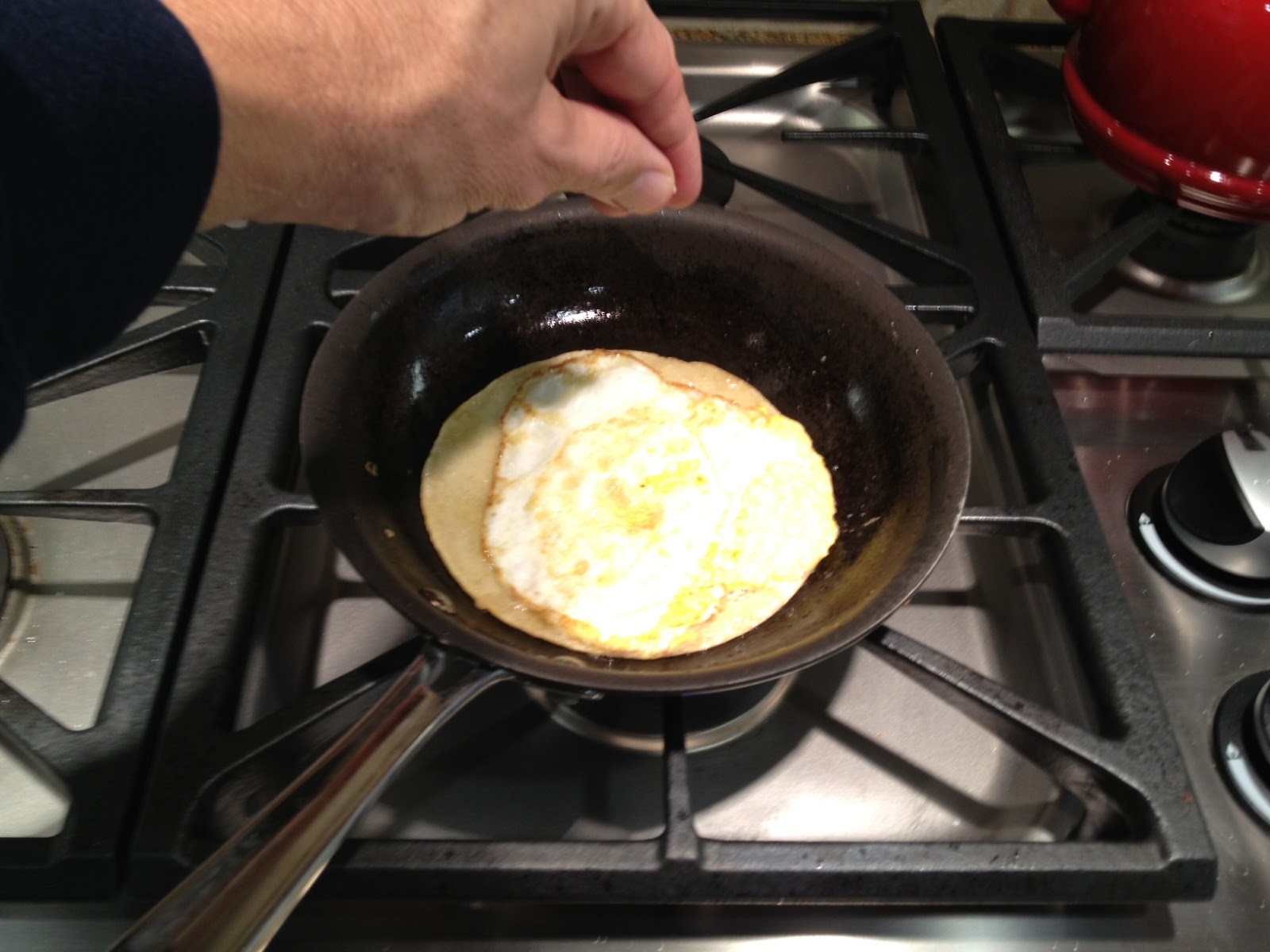
Once the oil is hot, roll the pan around to spread it evenly, then crack one of the eggs into the middle of the pan. (If the egg yolk rides up onto the sides of the pan, you can have problems later.) The egg should sizzle when it hits the pan.


Immediately after cracking the egg into the pan, puncture the yolk with the corner of your spatula.


Immediately after puncturing the yolk, place the tortilla over the top of the egg. You want to do this before the egg cooks at all so that the egg will adhere to tortilla.


Let the egg cook with the tortilla over it for about 2 minutes, or to whatever your taste is for fried eggs. I like mine over easy, and 1-2 minutes usually does the trick for me.


At this point you should be able to pick up the skillet and slide the cooking huevodilla around on the oil. If you're a pro chef, you can flip the huevodilla like an omelet, but if you're a poser like me, you'll want to slide your spatula under the egg and flip it so the tortilla side is down, then immediately season with salt...


...and some fresh-ground pepper.


Place the grated cheese onto the egg, slightly off to one side. (You'll be folding the tortilla in half in a few seconds.)


Spoon the salsa in on top of the cheese.


With your spatula, fold the egg-only side of the tortilla over onto the cheese-and-salsa side.


And you're done. Cooking the huevodilla for another 30-60 seconds is fine, but there's enough heat in there at this point to melt the cheese, so it's not necessary to do that.


If you're smart like me, you'll serve this one to your wife while you make a couple for yourself.

These are great served with cold orange juice to take the sting off the hot salsa, and make sure you've got some paper towels handy, because these can be some messy eating. (Think of La Fiesta soft tacos.)

Enjoy!

Friday, June 1, 2012

Progress Flagging on Your Novel? Try This

Picture this: You have been working on a novel for, say, five years or so...

You find your progress flagging, say, because you've got a bone-crushing day job that is sucking every ounce of pep out of you...

This happens just as you are ready bring that first draft in for a rocky, perhaps dangerous, yet invigorating landing...

You find an opening in one of your frenetic days...you're ready to start again...but where? You're lost.

My advice: Print the damn thing out. Invest $24 bucks in a new InkJet cartridge, line the chapters up, and click the Print button. I did, and I ended up with this:

Untitled - First Draft - Five Years In
I knew I'd been writing for a while, but I had no idea I'd produced that much. Even if half of it is complete crap (the realistic assumption for a first draft), I'm like, dude, you've got something substantial here, something with some heft to it...

Something worth sticking with for a while.

Sunday, March 18, 2012

Arthur Phillips and the American Worldview

(Long) After the Fact: A look at Arthur Phillips' first novel


On Arthur Phillips’ website, the following pivotal passage is included in the synopsis of Prague, his first novel:


What does it mean to fret about your fledgling career when the man across the table was tortured by two different regimes? How does your short, uneventful life compare to the lives of those who actually resisted, fought, and died? What does your angst mean in a city still pocked with bullet holes from war and crushed rebellion?
These words are placed in the mouths of the novel’s principal characters, a group of twentysomething American expatriates who seek adventure and understanding in the newly freed Eastern bloc. And what struck me in reading the passage was that this outsized narrative covering a year’s time in 1990-91 Budapest is remarkable ten years after its publication not only for its wit, style, and poignancy, but also for its portrayal of a world in which very little has changed. Emerging from the novel, one could easily see young Americans today in post-revolutionary Tunisia or Egypt asking exactly the same questions and arriving at exactly the same non-answers.

In other words, the story resonates. But that resonance comes not only from the moment in history the story captures, but also from the author’s seemingly effortless command of his art. Each sitting takes the reader on a gliding ride through imagery and emotion that is vivid, at times piercing, but always easy to digest. Even the massive interlude Phillips injects in Part Two is completely painless, and in fact invigorating. Here we are treated to hundreds of years of Hungarian history given as backstory for one of the novel’s few aged characters, a device that illuminates the character, takes us on a exhilarating flight, and lays a solid foundation for the remainder of the story.

As it turns out, I have once again let a book sit on the shelf for much too long. Phillips has delivered four novels since Prague, all to great critical acclaim. But I figure arriving at the party late is much preferred to not arriving at all.

Tuesday, December 27, 2011

Aestheticism v. Daniel Woodrell

James Wood, in How Fiction Works, talks about “aestheticism,” using as one of his examples a passage from John Updike’s Terrorist. In the passage, Updike’s young protagonist, the high-school–aged Muslim American Ahmad, walks down a street. We are in his thoughts as he ponders a recent growth spurt, then Updike suddenly takes over and launches into his own authorial exploration of Islamic theology, his exquisite lyrical prose replacing the direct rhythms of the young man’s thoughts.

One of the wonderful things about Wood’s little book is that it beautifully articulates thoughts we have already had, and in this case, he is articulating what has been my recent tendency to acknowledge and disparage aestheticism in many of the books and stories I’ve been reading. This will sometimes lead to my reading passages to my wife, absurdly embellishing them in the reading, laughing, and rolling my eyes.

It was my intention at the start of this post to find just such a flowery passage in Daniel Woodrell’s 2006 novel, Winter’s Bone, and to reprint it here for comical contrasting against the hillfolk dialog sprinkled elsewhere in the novel. But what I found instead were passages of description that, while certainly stretching the distance between themselves and the drawling Ozark Mountain dialog, do not break that distance. The tether is taut, but sill intact.

Here, the protagonist, Ree Dolly, is walking back from squirrel-hunting on family land with her brothers, two young boys she cares for as a mother:
The sun was taller though light had not yet broken through to the ground. The path was narrow and iced on the north slope. These rough acres were Bromont acres and they’d never been razed for timber, so the biggest old trees in the area stood on this ground. Magically fat and towering oak trees with limbs grown into pleasingly akimbo swirls were common. Hickory, sycamore, and all the rest prospered as well. (pg. 105)
While this is remarkable writing (phrases like “pleasingly akimbo swirls” could even be called magical), what is most amazing is how it stands in harmony with the very real speech of Ozark Mountain youths found in dialog like this, on the very next page:
Harold said, “Ree, are these for fryin’ or for stewin’?”

“Which way do you like best?”

Both boys said, “Fried!”

“Okey-doke. Fried, then. With biscuits, maybe, if we got the makin’s, and spang dripped on top, too. But, first thing is, we got to clean ‘em. Sonny, you fetch the skinnin’ board. I think it’s still leanin’ on the side of the shed back there. Harold, you go for the knife—you know which one I want.”

The one I ain’t s’posed to never touch.”

“Bring it to me.” (pg. 106)
I’m sure those comical passages are in there and just not presenting themselves at the moment, but I think it’s safe to say that by and large, Woodrell has succeeded wildly in writing as his Ozark Mountain family and neighbors spoke, and in either recapturing or inventing the words and rhythms of the most eloquent of those family and neighbors for use in his exposition. The result—despite the sniggering of a sometimes pretentious Californian—is not only stylish writing, but easy reading.

Wednesday, November 2, 2011

Movember - Shameless Plug for Donations

Okay gang, October is behind us, which means it's time to get the pink off the football fields, shift the focus to the men, and start growing some facial hair! (Word: We strongly encourage ongoing support for breast cancer and women's health causes throughout the year, so always do what you can.)

This MOvember, I've joined a team of colleagues from Cisco to support the Prostate Cancer Foundation and Livestrong by growing moustaches for men's health. Go to the Deucerman's MoBro Page and do the following: 1. Watch the day-to-day progress of my pathetic liphair struggling to the surface, and 2. Kick in some scratch! We have a set a stretch goal for our Movember Team, the MoMigos, of $250 Million, so we obviously need every penny you can spare. So ask yourself: Does that kid really need those braces? Does Grandpa really need that knee replacement? Does Grandma really need that hip replacement? I mean, God gave us chairs and couches, right?!

Okay, enough goofing. Let's get serious for a minute:

The Problem 
  • Based on rates from 2005-2007, 1 in 6 men born today will be diagnosed with prostate cancer during their lifetimes.
  • Based data from the same period, nearly 3% of men will die from prostate cancer.
The Solution
  • The Prostate Cancer Foundation has funded more than 1,500 programs at nearly 200 research centers in 12 countries.
  • Movember and Livestrong are teaming up to offer free, confidential navigation resources to any man affected by any cancer at any age.
  • In 2010, over 64,500 US Mo Bros and Mo Sistas got on board with Movember, raising $7.5 million USD.
So give us a hand. Go to the Deucerman's MoBro Page and make whatever donation you can.

Tuesday, November 1, 2011

In the Market for a New Lawnmower

My response to the person who showered the Occupy Wall Street protesters with copies of this little missive.

Dear Person,

Thank you for your missive. It was very revealing. A minor edit and a message to you: To the list of things you would sell, you forgot a few: your mother, your children’s future, your country…down the river…just to name a few. And that doesn’t make you vicious. It makes you a greedy coward and a traitor. And yes, occupiers didn’t take to the streets when the markets rose. Congratulations. You pulled the wool over our eyes. There were those, people smarter than you, who tried to warn us, but we didn’t listen. And the occupiers’ message to you now is, that isn’t going to happen again.

Now let’s clear a few more things up: The markets you manipulate are not “just like gambling.” What you guys don’t get is that Wall Street is not a casino, it is a system designed to capitalize good ideas, not make a pack of punk-ass bitches like you rich. (And no, capitalized debt obligations, derivatives, and mortgage-backed securities do not qualify as “good ideas.”) The other thing you don’t get—well, actually, you do (see below)—is that in a democracy, that system is dependent on the people. If it does things the people don’t like, the people will either change it or shut its ass down. Welcome to your nightmare.

And no, you’re not going to take employment away from any occupiers, for two reasons. First, most of them aren't employed, thanks to you. And second, those who are employed are doing things that will find no value whatsoever in your snakelike acumen for “positions” and “gambling.” In case you need a primer, that’s how the market works: you ain’t a software engineer, you ain’t a physics lecturer, you ain’t a social worker or an occupational therapist or an electrician or a structural engineer, so ain’t nobody going to hire you to do those things. I don’t know what cloud of self-delusion led you to believe that the occupiers were mowing lawns, because I can tell you, any occupiers who are mowing lawns or making sandwiches are only doing so because their college degrees aren’t dong them any good in a system where punk-ass bitches like you suck up all the capital that is meant to fuel ideas, innovation, and the American future. So no, you won’t be taking anyone’s jobs, because clearly, you are incapable of teaching third-graders.

(And by the way, your time is near. I’d suggest you start looking for lawns to mow.)

And that car of yours? It never should have cost $85K in the first place. And the occupiers aren’t going to “create jobs” that depend on your 35% tip. They’re going to rebuild the system, and then they're going to create vocations, and those vocations are going to drive stronger, steadier, and more stable economic growth than any of your ingenious collateralized debt obligations ever could have.

But of course, you know all this, because you took the time to craft this little missive, give it to your admin to copy, and climb onto the roof to throw it down. And why would you do that? Why on earth would a snake like you do that, an asp, a cobra, a python like you, who could have spent that time “making” what, $50K, $100K, screw it, a million dollars, let’s say? The message of your missive is clear, my friend: you are afraid. You are quaking and pissing yourself like a crackhead right now, which is why you think you need an 85,000-dollar tank to protect you from all those baaaad people out there.

Word, dude: You don’t. They’re just people trying to make a better world.